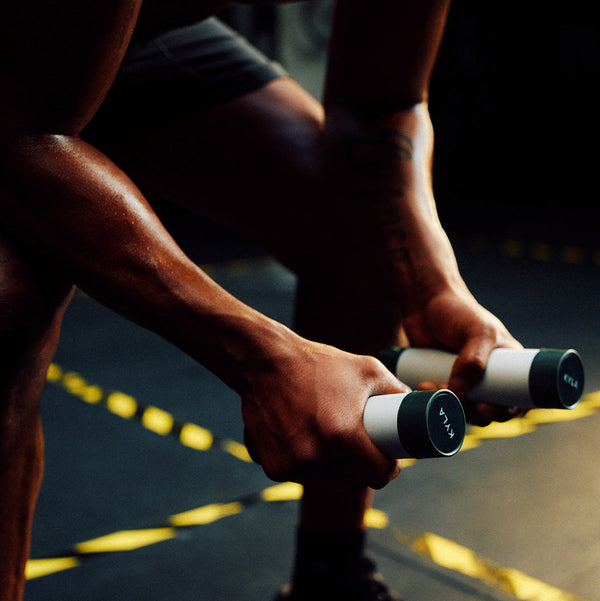

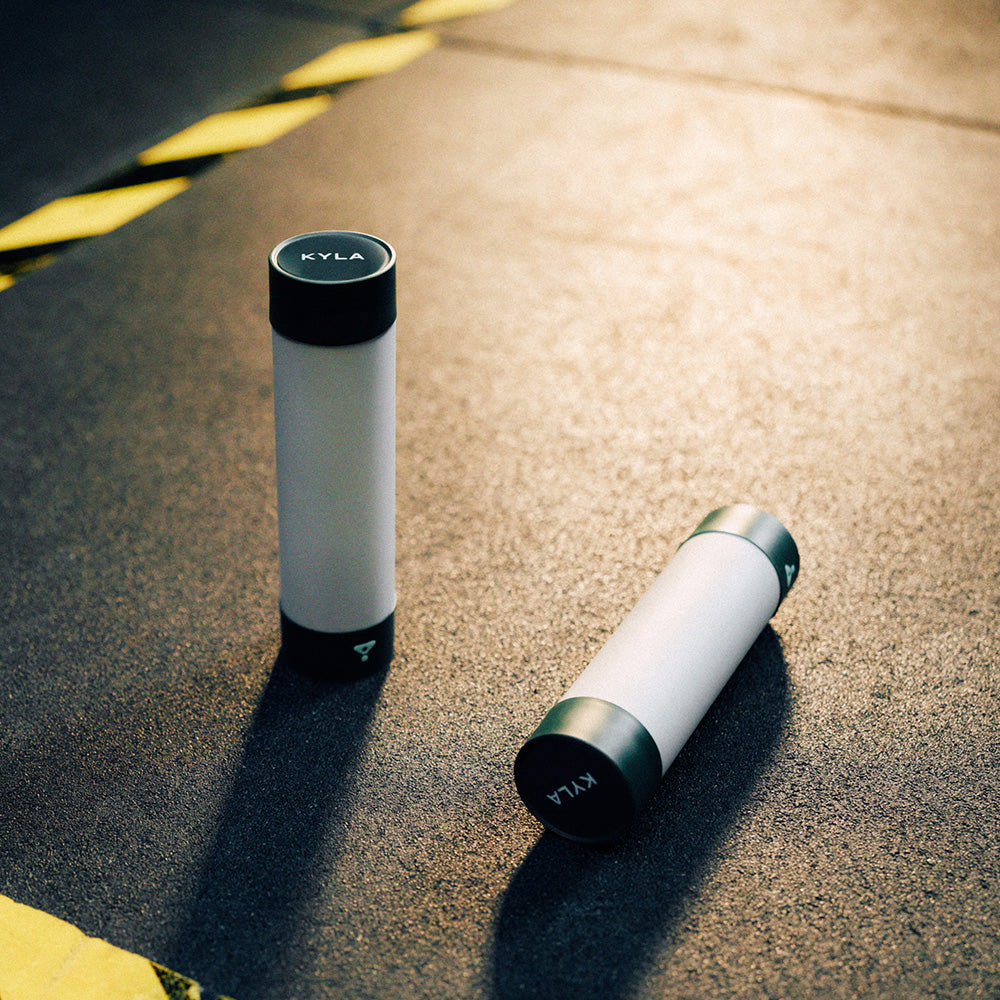
There are two kinds of palm cooling device. One has a battery, a Peltier element and a fan, and holds a surface at a set temperature until the battery runs out. The other has no electronics at all: a cold core inside a conductive shell, chilled in a fridge or freezer, that gives up its cold as you hold it.
Electric sounds like the serious one. In a palm cooler, most of the time, it is the weaker one. Here is why, and what a battery does buy you.
What a Peltier element can do in your hand
A thermoelectric (Peltier) element moves heat from one face to the other when you run current through it. Two things limit it in a handheld device.
First, it is inefficient. A Peltier moving heat across a useful temperature difference has a coefficient of performance well under one: for every watt of heat it pulls from your palm it needs more than a watt of electricity, and it dumps both on the hot side. A battery that fits in a handle holds tens of watt-hours. Spread across an hour of use, that is an electrical budget of a few tens of watts, of which perhaps a third arrives as cooling at your palm.
Second, the hot side has to get rid of all of it, into the air, through a heat sink and a small fan that also fit in your hand. If the hot side cannot shed the heat, the cold side stops being cold. That is the binding limit in every handheld Peltier we have looked at, and it is why they hold their setpoint steadily but at a low rate.
Our physics estimate for the handheld Peltier products on the market, from their published battery capacities and run times, is single-digit watts of heat removed per palm, held steadily for the published hour or two. Their makers do not publish delivered watts, and neither does anyone else in the category, including us; these are modelled figures.
What a passive device can do in your hand
A passive device has no supply limit at the surface. Its limit is how fast heat can travel from your skin into the cold core, and how much cold the core holds.
The first is set by contact and construction. A firm grip on a conductive shell, with a core that stays cold right behind the shell, lets heat leave your palm at the rate your blood delivers it. For a heat-stressed athlete that biological ceiling is several times higher than what a handheld Peltier supplies. A passive device with poor construction, a water-filled bar or a gel pack in fabric, falls off that ceiling within the first grip, because a layer of warmed material builds up under your hand and the surface drifts. A phase-change core with internal conduction paths does not: the whole core supplies the surface, so it returns to its plateau between sets. (Our construction is described in The engineering.)
The second, how much it carries, is a fixed number: mass of phase-change material times its latent heat. For KYLA Performance that works out to roughly 35 to 40 minutes of effective contact per pair. That sounds short until you count how long you actually hold a cooler in a two-hour session: sixty to ninety seconds per rest, ten to twenty rests. It is enough, with margin, and it is why we say a pair covers a session rather than a day.
So what does the battery buy you?
Steadiness over a long time. A Peltier device at 13 to 16 °C is still at 13 to 16 °C after ninety minutes. A passive device is, by then, into the last of its reserve if you have used it hard. For a two-hour gym session that does not matter. For a five-hour tennis match in the sun, or for a physio who wants to treat clients back to back all afternoon, it can. The tethered systems (an ice-water mitt with a console, a mains-powered bench chiller) are the real answer to that need, at the cost of being tethered.
The battery also buys you an adjustable temperature, which is not a benefit. Below roughly 14 °C the vessels in the palm start to close and less heat arrives to be removed. A device that can be set to 8 °C, or 5 °C, can be set into the zone where it works against you, and people who believe colder is stronger will do exactly that. A phase-change plateau cannot be set wrong. (Is colder better?)
The honest summary
For heat removed per rest between efforts, a well-built passive device wins, by a margin set by physics rather than by marketing. For holding a temperature over hours, a battery or a tether wins. Choose by how you train. If your sessions are one to two hours with rests in between, the passive device is the stronger tool and the one that is still in your bag in March. If you need hours of cooling in one place, look at the tethered systems.
We built KYLA Performance for the first case: palm cooling between sets, in the rests you already have. What is palm cooling? goes through the kinds of device on the market, and KYLA Performance is the one we make.