
The first thirty seconds of rest matter most because that is when the body is hottest and the temperature gap driving heat loss is widest. Cooling is fastest in that window and fades after. The physics behind it is not new.
In 1701, Isaac Newton published a short paper that has since been folded into the textbook of every undergraduate physics course. It described, with characteristic spareness, the rate at which a hot object loses heat to its surroundings.
The relationship he identified is now called Newton's Law of Cooling, and it states something simple. The rate at which an object loses heat is proportional to the temperature difference between the object and its environment.
The non-obvious consequence
This sounds obvious. In practice, it has consequences that are not.
The consequence that matters most, when you think about cooling the human body, is that a large temperature gradient produces fast cooling, and a small temperature gradient produces slow cooling. The relationship is exponential rather than linear. A body at 39 degrees in a 20 degree room loses heat faster, by a wide margin, than the same body at 37.5 degrees in the same room.
This is why ice baths feel intense in the first 10 seconds and then less so as the immersion continues. Not because the water has warmed up appreciably, but because the skin and shallow tissues have cooled to a point where the gradient narrows. The remaining heat exchange happens more slowly. Most of the cooling work is done in the first portion of the immersion. The rest is diminishing returns.
What this means for rest periods
The implication for athletes managing heat during training is non-obvious and worth sitting with. The body is producing heat continuously during a working set. By the time the set ends, the body is at its hottest. That is precisely the moment when the cooling gradient is largest, and when cooling is most efficient. The body's ability to shed heat per minute is higher at the start of a rest period than later in it.
Most rest periods are not designed around this fact. The athlete completes a set, lets the heart rate come down, drinks some water, and starts the next set. The rest period is treated as a passive interval. The window where the body's thermoregulation is most responsive (the first thirty to sixty seconds after effort) usually passes without an active intervention.
Why palm cooling outperforms intuition
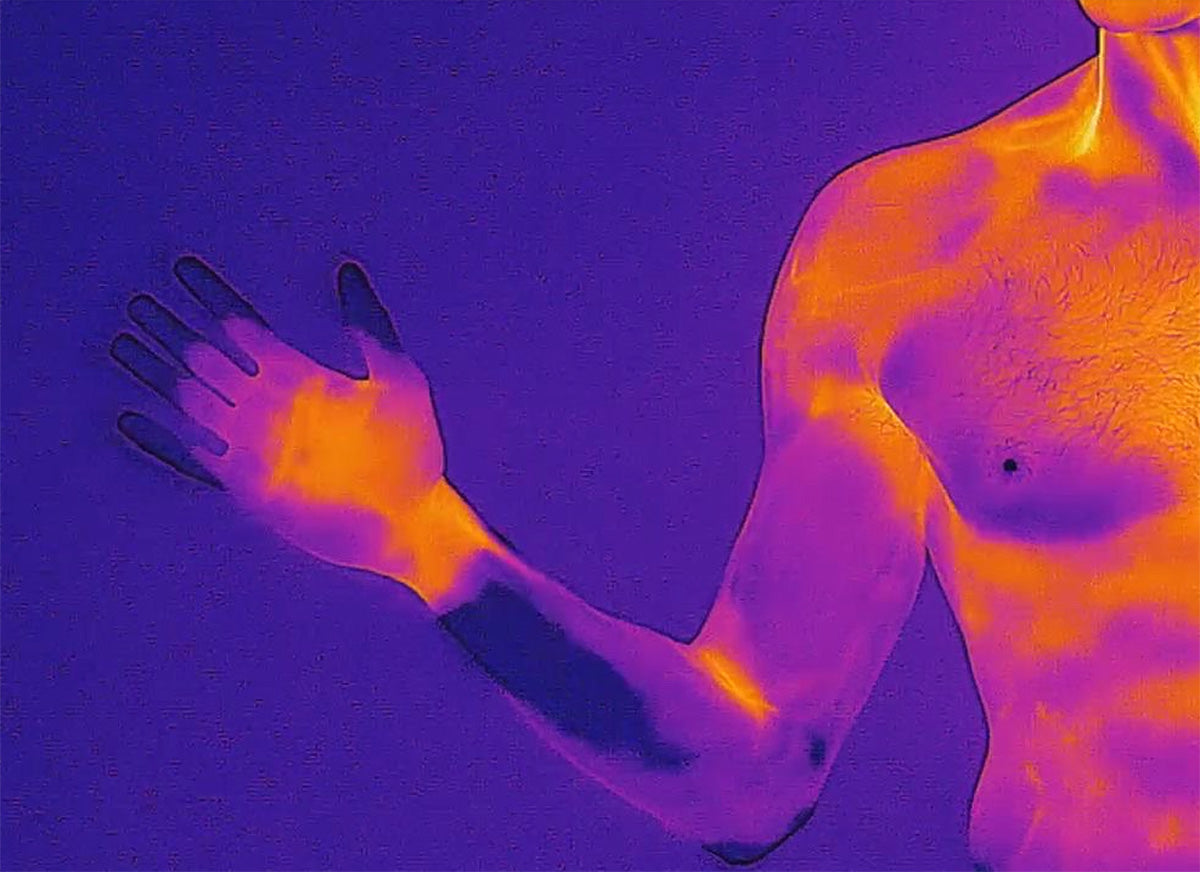
This is one of the reasons palm cooling research has consistently shown an effect larger than intuition would predict. The intervention is short, targeted, and applied when the gradient is wide. The body moves heat through the palms efficiently because of the vascular architecture, and the cooling surface accepts that heat efficiently because the gradient is large. The physics is working in the athlete's favour during the first minute after a hard set. After that minute, the returns diminish.
There is a broader principle hiding inside the math. Cooling is not a steady process. It is front-loaded. The first thirty seconds matter more than the next two minutes. This is true for ice baths, for cold towels at tennis changeovers, for cooling vests in Olympic warm-ups, and for the kind of contact cooling that happens when an athlete grips a thermally conductive surface between efforts.
Why timing matters more than people think
The reverse is also true. If you wait too long to intervene, the gradient has already narrowed, and the same intervention does less work. The advice to cool down between sets understates the timing. The body wants the intervention to happen at the start of the rest period, not at the end of it.
Newton on cups of tea
Newton did not write his paper with athletes in mind. He wrote it with cooling cups of tea in mind, and with the rate at which iron loses heat as it sits on a smith's bench. But the law is the same. The conditions that maximise heat exchange are the conditions that exist for a short window after the body has just produced a lot of it.
If you are going to manage thermal load in training, the math says do it early. The methodology page details how we time the intervention in our own testing protocols.
Frequently asked questions
What is Newton's Law of Cooling in simple terms?
The bigger the temperature difference between a body and its surroundings, the faster it loses heat. The relationship is exponential, so a hotter body sheds heat much faster than a slightly warm one.
Does that mean colder is always better for cooling?
Not for the body. Very cold surfaces make the blood vessels in the skin constrict, which slows heat transfer. There is a window where the gradient is useful and the vessels stay open.
Why does an ice bath feel intense at first and then less so?
The gradient is largest in the first seconds, so cooling is fastest then. As your skin cools, the difference shrinks and the rate drops.