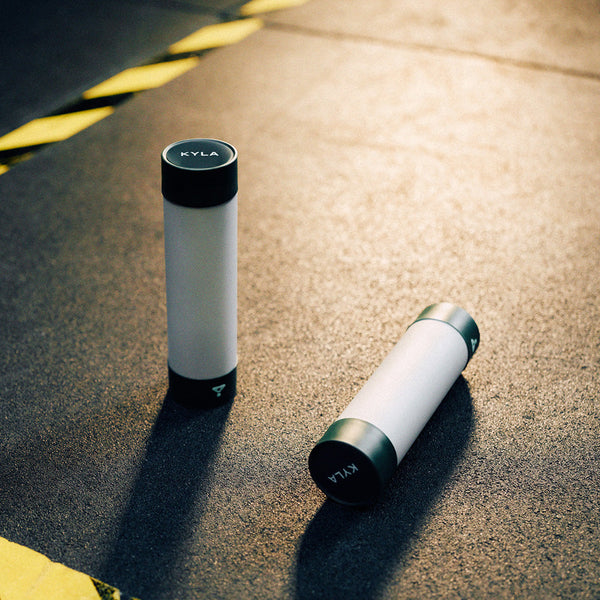


KYLA borrows one idea from fields far outside sport: heat has to be removed at the rate the body produces it. Space programs, desert militaries, and Olympic teams all worked that out first.
The history of cooling under physical load is not a sports story. It is a story about environments where the cost of getting it wrong was not a slow training day. It was equipment failure, mission failure, or death.
NASA's Apollo problem
In the 1960s, NASA engineers working on the Apollo program had to solve a problem that was not, at first, what people expected. Going to the moon meant designing a spacesuit that could keep an astronaut alive outside the spacecraft. Most of the conversation in the public imagination is about oxygen and pressure. The harder engineering problem was heat.
A person doing physical work inside a sealed suit generates significant metabolic heat. In space, there is no convection and no airflow. Heat cannot leave the suit on its own. NASA's solution was the Liquid Cooling Garment: a fitted layer of tubing worn under the pressure suit, circulating chilled water across the body, removing heat at the rate the astronaut was producing it. It was not a luxury. Without it, the suit would have become unwearable within minutes.
That technology was developed sixty years ago. The basic principle, that heat must be removed at the rate it is produced, has since been adapted across other serious environments.
The military's heat illness problem
The US military has the same problem. Soldiers operating in desert conditions, particularly inside vehicles or wearing protective gear, generate heat the body cannot disperse fast enough through normal means. The Army Research Institute of Environmental Medicine has spent decades developing cooling protocols, garments, and pre-cooling strategies for sustained operations in hot climates. The investment in cooling is proportional to the cost of not having it.
Olympic pre-cooling
Olympic teams discovered the same logic earlier than most of professional sport. Pre-cooling vests appeared in distance running and cycling teams in the late 1990s and 2000s, used between warm-up and competition to lower core temperature before the gun. Australian and British teams were early adopters. The research community had been clear for years that core temperature at the start of an effort affects how long that effort can be sustained. The elite end of sport eventually built it into the warm-up protocol.
The pattern
What you notice, looking across these domains, is a pattern. The environments that took heat most seriously were the ones where the consequences were highest. Space. Desert combat. Olympic finals. In each case, the people responsible for performance treated cooling not as a comfort option but as a core engineering variable.
Mainstream training has been slower to adopt this view. The conversation is about sleep, nutrition, and post-session protocols. Heat during the session itself is treated as something the athlete simply has to push through, or as a problem solved by drinking water.
This is starting to shift. Cooling is becoming more visible in elite endurance, in combat sports, in tennis at the highest level, where players use cold towels and ice during changeovers because the difference between winning and losing the third set has, in some cases, come down to who stayed cooler. KYLA Performance™ takes the same principle, heat removed at the rate it is produced, and builds it for the space between efforts.