

The first law of thermodynamics is, in its simplest form, a rule about accounting. Energy is never created and never destroyed. It is only transferred from one place to another, or converted from one form to another. Anything that produces energy must release it, or it accumulates.
This is why almost every machine that does work has been engineered with that fact in mind.
A car engine has an exhaust. Without one, combustion heat would build inside the cylinders until the engine destroyed itself. A hair dryer has a fan that pulls air across its heating element, because without that airflow the element would melt the housing around it. A laptop has a heatsink. A power station has a cooling tower. A nuclear reactor has a coolant loop. In each case, the system was designed not around what produces the energy, but around what removes it.
The bottleneck is downstream
This is the part most people forget. The engineering problem is rarely the production of energy. It is the disposal of it.
A high-performance car with a thousand horsepower does not fail because the engine cannot generate that much force. It fails because the heat the engine produces has nowhere to go fast enough. Throttle output drops not because the engine has run out of capacity, but because the thermal management system has reached its limit. The bottleneck sits downstream of the source.
The body as a heat engine
The human body is a heat engine of the same kind.
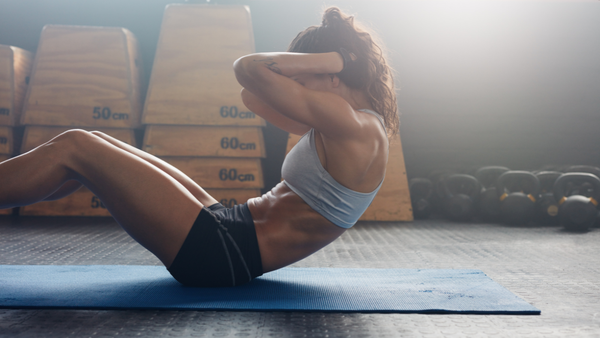
During training, every contraction your muscles perform converts chemical energy into mechanical work and, as a byproduct, into heat. Roughly 70 to 80 percent of the energy released during muscle contraction is heat. The mechanical work that gets you up the hill, lifts the bar, or finishes the interval is the smaller fraction. The larger fraction is thermal load that has to be moved out of the body before it limits what the body can do next.
The body has a thermoregulation system. Sweat evaporates from the skin. Blood vessels near the surface dilate. Heart rate rises in part to push warm blood from the core to the periphery, where it can shed heat. All of this works. None of it works fast enough at the upper edge of effort.
When heat accumulates faster than the body can disperse it, the central nervous system does what an engine control unit does in a car. It reduces output. Not because the muscles are exhausted. Because the system is protecting itself from thermal damage. You slow down before you have to. You feel the weight get heavier. You feel the interval get longer. The variable that changed was not your fitness. It was the heat your body had nowhere to put.
The route out
This is where the design problem starts to look familiar. If the bottleneck is not energy production but energy transfer, then the question is no longer how to train harder. It is how to build a better outlet.
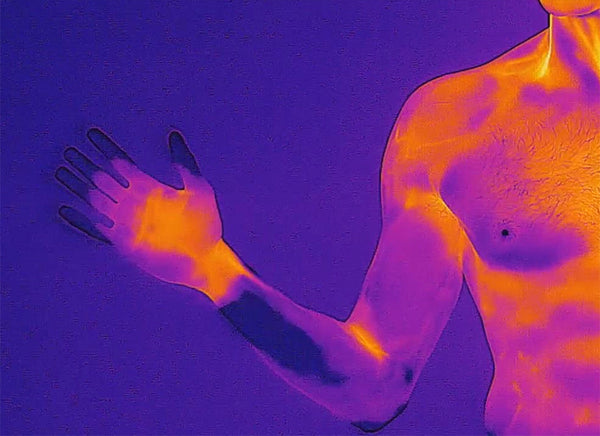
The body already has one. Three areas of skin are disproportionately efficient at heat exchange: the palms of the hands, the soles of the feet, and the face. These regions are glabrous, meaning hairless, and they contain specialised vascular structures called arteriovenous anastomoses. These are short, direct connections between arteries and veins that allow blood to bypass the capillary bed and flow in much larger volumes close to the skin surface. When the body needs to shed heat quickly, blood is redirected through these pathways. They are the body's high-bandwidth thermal outlets.
The principle is the same as water finding the easiest path. Heat moves where the resistance is lowest. In the human body, that path runs through the palms.
But the body's outlets are not always enough. At the upper edge of training, they cannot move heat fast enough to prevent output reduction. This is the gap. Athletes do not slow down because they are weak. They slow down because the route out is too narrow.
The whole product on one line
What KYLA has built is, in the simplest possible terms, an extension of that route. A surface with the thermal properties to accept heat from the palm at the rate the body wants to release it. Held during the rest period between efforts, it gives the heat somewhere to go. Not faster than physics allows, but as fast as physics allows.
This is not a cooling trick. It is not a wellness gadget. It is a thermal route, built deliberately, for the specific moment in training when the body is trying to move heat and has nowhere efficient to send it.
You cannot destroy heat. You can only move it.
The whole product is built on that one line. The methodology page details how we measured the heat-transfer rate in practice. Everything else follows from the physics.
Frequently asked questions
What does 'you cannot destroy heat' mean for the body?
The first law of thermodynamics says energy is only moved or converted, never destroyed. The heat your body makes has to go somewhere, or it accumulates.
Why does that matter in training?
Because you cannot make the heat disappear, only relocate it. The goal is to move it out of the body faster than the next effort adds more.
How do you move heat out efficiently?
Through the routes the body built for it, like the palms, during the rest periods when the heat would otherwise sit and build.