
Ice bath vs palm cooling is not a fair fight, because the two are not doing the same job. An ice bath is whole-body cold exposure, usually after training, aimed at how you feel afterwards. Palm cooling is a targeted way to move heat out of the body during training, in the rest between efforts.
Both are cold. That is where the similarity ends. One is about recovery after the session is over. The other is about holding output while the session is still running.
It is worth being precise, because the two are often discussed as competing versions of the same idea. They are not. They differ in what they cool, how much heat they actually move, when they are used, and what the evidence supports.
What an ice bath actually does
An ice bath, or cold water immersion, puts most of the body into cold water for several minutes after training. Two things follow. The skin and the tissue near it cool quickly. And blood vessels near the surface constrict, which reduces blood flow to the periphery.
The reliable effect is on how you feel. Athletes consistently report less soreness and less perceived fatigue in the days after cold water immersion. That is a real benefit if the next session matters more than this one's adaptation.
The less comfortable finding is what happens across a training block. Fyfe and colleagues (2019) trained sixteen men for seven weeks, each session followed by either fifteen minutes at 10°C or passive recovery. Maximal strength improved similarly in both groups. Type II muscle fibre growth was blunted in the cold water group.
Their conclusion was direct: post-exercise cold water immersion should be avoided if muscle hypertrophy is the goal. A later review by Petersen and Fyfe (2021) reached the same broad position. Cold water immersion after resistance training appears to attenuate some adaptations, while endurance adaptations seem unaffected. That is not a reason to abandon ice baths. It is a reason to be deliberate about when you take one.
What palm cooling actually does
Palm cooling works on a different principle. The palms, the soles and the face carry glabrous skin, which is skin without hair. Underneath it sits a dense network of vessels called arteriovenous anastomoses, which shunt blood between the core and the surface.
Walløe (2016) describes the density of these vessels, reaching roughly 600 per square centimetre in the nail beds and around 100 per square centimetre in the palm. That anatomy exists for temperature control. It is a heat valve, and it opens when the body is warm.
The practical consequence is that you can move a meaningful amount of heat through a small surface area, and do it while the athlete is sitting down between efforts rather than lying in a tub afterwards. More on how heat leaves the body through the palms.
Colder is not automatically better
This is where the ice bath instinct works against you.
Cold you can feel is not the same as heat leaving the body. Push the local temperature of the palm too low and the vessels underneath constrict. The skin reports cold. The shunt closes. Less heat moves, not more.
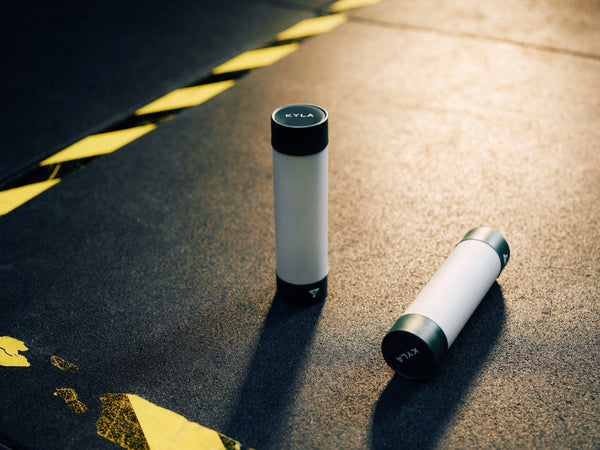
An ice pack solves for sensation. It is very cold, it feels like it is doing something, and it loses its cold quickly once it starts working. A tool built for heat transfer solves for the opposite: hold a temperature warm enough to keep the vessels open, and hold it for the whole rest period. KYLA Performance is designed around roughly 14°C for exactly this reason.
The same logic applies to the tub. Very cold water is efficient at cooling skin. It is less efficient at moving heat out of the core, because the body answers by shutting down peripheral blood flow.
The timing question nobody asks
The clearest difference is not temperature. It is when the cooling happens.
An ice bath happens after the work is finished. Whatever it does, it does to recovery, adaptation and how you feel tomorrow. It cannot change the session that just ended.
Palm cooling happens inside the session, in the ninety seconds between sets or the transition between stations. If it works, it works on the effort that has not happened yet.
Which also means they do not compete. Nothing stops an athlete cooling the palms between intervals and taking a cold plunge two days before a race. They answer separate questions.
What the evidence supports, and what it does not
The mechanism behind palm cooling is not in doubt. Glabrous skin moves heat, and cooling it lowers core temperature faster than cooling other sites. That part is settled physiology.
The size of the performance effect is disputed, and we would rather say so than pretend otherwise. Studies disagree, and the disagreement is not random. What device was used matters, because a water-cooled mitt, a vacuum-assisted lab rig and an ice pack are not the same intervention. When the cooling is applied matters. How long it is held matters. And most of all, how much heat the session actually produces matters.
The pattern across the literature is that cooling looks most useful where the thermal load is real: repeated hard efforts, heat, formats with short transitions. It looks least useful in low-volume lifting in a cool gym, where core temperature barely moves in the first place. We publish the studies that cut against us alongside the ones that support us on our references page.
Which one, and when
- Use an ice bath when the priority is feeling better tomorrow: a competition block, a tournament, back-to-back race days, a heavy period where the next session matters more than this one's adaptation.
- Avoid an ice bath immediately after resistance training you are doing specifically to build muscle, on the evidence from Fyfe and colleagues.
- Use palm cooling when the limiter is inside the session: repeated hard efforts, intervals, hybrid formats, hot conditions, anywhere output fades across a session rather than failing in one set.
- Expect less from palm cooling in short, low-volume, heavy work in a cool room. If the session does not build heat, there is less for it to move.
Common questions
Is an ice bath bad for you?
No. It is well tolerated and it reliably reduces how sore and fatigued athletes feel. The caution is narrower than the internet suggests: taking one straight after resistance training you are doing to build muscle appears to blunt some of that adaptation.
Can I just hold an ice pack between sets instead?
You can, and plenty of people do. The problem is that an ice pack sits far below the temperature where the vessels in the palm stay open, and it loses its cold quickly. You get a strong cold sensation and less heat transfer than you would expect.
Does palm cooling replace an ice bath?
No. They act at different points. One is about the session you are in. The other is about the days after it. Some athletes use both, for different reasons.
Which one should I try first?
Start with the problem, not the method. If you are sore between sessions, look at the ice bath question. If your fourth set is nothing like your first, that is a within-session problem and cold water afterwards will not touch it.
What this means for training
Ice baths and palm cooling are not rivals. They are tools for different moments, and treating them as interchangeable is how people end up cooling at the wrong time for the wrong reason.
If the thing you want to change is how the session goes, the intervention has to happen inside the session. KYLA Performance is built for that window, and we set out what we measured and what we did not on the methodology page.
The tool does not replace the work. It lets more of the work count.
References
Fyfe, J. J., et al. (2019). Cold water immersion attenuates anabolic signaling and skeletal muscle fiber hypertrophy, but not strength gain, following whole-body resistance training. Journal of Applied Physiology, 127(5), 1403-1418. PMID 31513450.
Petersen, A. C., & Fyfe, J. J. (2021). Post-exercise Cold Water Immersion Effects on Physiological Adaptations to Resistance Training. Frontiers in Sports and Active Living, 3, 660291. PMID 33898988.
Walløe, L. (2016). Arterio-venous anastomoses in the human skin and their role in temperature control. Temperature, 3(1), 92-103. PMID 27227081.