

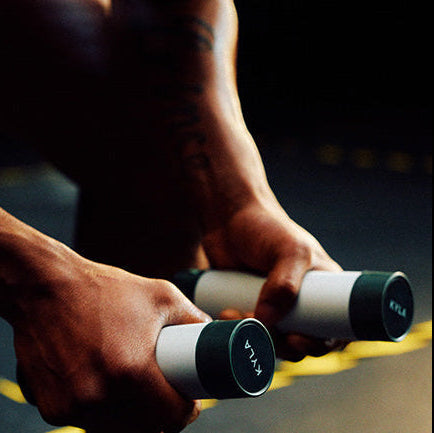
Does palm cooling work? In short, yes, as a way to move heat out of the body during rest, because the palm is one of the skin's most efficient heat-release zones. The established mechanism is pre-cooling. Whether it improves any single session depends on the heat, the effort, and the athlete.
Does palm cooling work, and what does it actually do?
Start with the plain version. When you hold something cool in your hand, heat leaves your body through the skin of your palm. During rest between efforts, that lost heat is heat your body no longer has to carry into the next effort. The mechanism underneath is heat transfer, but you do not need that term to feel the effect. Palm cooling is a way to shed heat quickly, in the short windows training gives you.
It is not cold therapy and not an ice pack. The goal is not to make you cold. The goal is to keep rising core temperature from becoming the thing that ends your session early.
Why does the palm release heat so well?
The palm is glabrous skin, meaning it has no hair. Skin like this, found on the palms, the soles, and the face, carries a dense network of specialised blood vessels that exist to exchange heat with the environment. Blood arrives warm, sits close to the surface, and leaves cooler. Few other parts of the body are built for this. It is why your hands feel the cold first, and why they are a sensible place to pull heat out on purpose.
What does the research actually show?
Here is the honest split. The mechanism, cooling the body to support performance in the heat, is established in peer-reviewed sport science. The size of the effect is where the picture gets more careful.
The clearest anchor is a meta-analysis by Bongers and colleagues, published in the British Journal of Sports Medicine in 2014, which examined pre-cooling and exercise performance in the heat across many studies. Earlier work by Drust, Cable and Reilly in 2000 looked at cooling in the same tradition. Taken together, this body of work supports pre-cooling as a real strategy for heat, while showing that results vary with the protocol, the athlete, and the conditions. The direction is well supported. A single guaranteed number for every situation is not, and anyone who offers you one is overselling.
KYLA's own product measurements are first-party and early. We publish them openly, with their limits stated, and an independent university study is underway. You can read what we measured and how for the method rather than the marketing.
Why 14 degrees, and not colder?
Colder is not better here, and this is the counter-intuitive part. KYLA Performance is engineered to work around 14 degrees C. Go much colder and the blood vessels in the palm constrict, narrowing to protect you, which slows the very heat transfer you were trying to speed up. A tool that feels aggressively cold can move less heat than one held at a temperature the vessels stay open for. The design point is chosen for flow, not for the sensation of ice. The full picture is on the science behind palm cooling.
Where does palm cooling fit, and where does it not?
Palm cooling fits in the rest. Between sets, between intervals, between stations, in the minutes when you are not moving but your temperature is still climbing. Used there, it lets you carry less accumulated heat into the next effort. It does not add fitness you have not built, and it will not rescue a session that failed for other reasons. You can see the tool on the KYLA Performance product page. The tool does not replace the work. It lets more of the work count.
Frequently asked questions
Is palm cooling the same as an ice bath?
No. An ice bath cools you broadly and deeply, often after training. Palm cooling is targeted and light, used in the short rests during training to shed heat as it builds. Different tools, different jobs.
Do I need to feel cold for it to work?
No, and feeling very cold can work against you. The palm moves heat best when its vessels stay open, which is why KYLA Performance is built to work around 14 degrees C rather than as cold as possible.
Will it make me stronger?
Not on its own. It does not build fitness. What it can do is limit how much heat you carry from one effort to the next, so more of your training happens before heat becomes the limiter.
Is the effect proven for everyone?
The mechanism is well established. The exact size of the benefit varies by person and conditions, which is why we publish our own early measurements openly and point to independent research rather than promising a single number.