

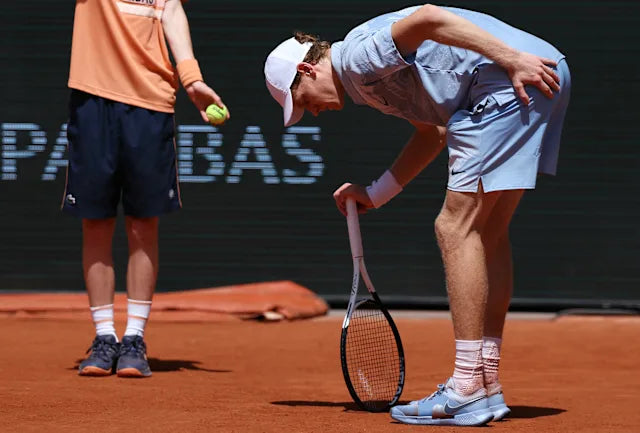
When Jannik Sinner went out at Roland Garros, he did not lose because his shots got worse. He lost because his body started doing exactly what the physiology textbooks predict it does in heat. It protected itself.
What the science says happens
In 2001, researchers Jose Gonzalez-Alonso and Jose Calbet ran one of the most replicated studies in modern exercise physiology. Trained cyclists rode to exhaustion in heated chambers. Across multiple trials, regardless of fitness or hydration, the riders stopped within a narrow window of core body temperature. Around 39.5 degrees Celsius. The ceiling was thermal, not muscular.
The mechanism is now well established. As core temperature climbs, the brain receives signals from thermoreceptors. When core temperature approaches a level that would cause cellular damage, the central nervous system reduces voluntary motor output. Power, speed, and precision degrade. The muscles are not exhausted. They are being throttled.
This is the mechanism that decides matches in heat. The player feels their legs go heavy, their shots fall short, their reaction time slow. It is not a failure of will. It is a centrally regulated protective response. Push past that point and the next stages are exertional heat illness, then heat stroke. Both carry real medical consequences.
Core temperature, not tissue temperature
The distinction that matters most, and the one that gets lost in most courtside conversations about cooling, is this.
The body throttles output based on core temperature. Not skin temperature. Not surface tissue temperature. Core. The deep visceral and central nervous system temperature that the brain monitors continuously through internal thermoreceptors. That is the signal driving the protective response.
A cooling intervention either lowers core temperature or it does not. The fact that the skin feels cooler, or that surface tissue temperature drops, does not necessarily reach the variable the brain is monitoring.
Why the standard interventions only go so far
Three things are usually done in heat. They are all useful. They all have limits.
Water and electrolytes. Drinking helps. But absorption is slow. From the moment a player drinks, it takes roughly ten minutes for the fluid to start affecting core temperature meaningfully. During those ten minutes, core temperature keeps climbing. The intervention lags the accumulation.
Ice bags on the neck. The cold feels intense, and the player reports feeling better quickly. But neck and chest cooling primarily acts on surface tissue and on the thermal sensors near the skin. The brain reads that signal as a cooler body, which can reduce the body's own thermoregulatory drive. Sweating decreases. Skin blood flow constricts. The core actually loses heat more slowly. The relief is perceptual. The core can stay hot, or keep climbing.
Ice in the hand. This is closer to right. The palm is one of the body's most efficient heat-release pathways. Hairless glabrous skin sits over arteriovenous anastomoses, vascular structures that allow blood to flow in large volumes near the surface for direct heat exchange. Cooling here moves real heat. But unstructured ice loses contact temperature within minutes, and below about 12 degrees Celsius the body constricts blood flow to the surface and the exchange shuts down.
What KYLA is
KYLA is built specifically for this. To remove heat from the core, not from the surface tissue.
The construction holds the palm in a controlled temperature window where the body's natural heat-release pathways stay open and active. Cold enough to keep drawing heat. Warm enough that the body keeps the blood flowing through the surface vessels.
In controlled testing, the magnitude of the difference is substantial. Ice bags at the neck move only a small fraction of the core heat per minute that KYLA does. Ice in the palms moves more, but still substantially less.
The principle
The mechanism that took Sinner out is the same mechanism that decides every match played in heat. It is well understood. It is not new.
The variable the brain is monitoring is core temperature. That is the variable a cooling intervention needs to move.
What does not reach the core does not affect the limit.
Frequently asked questions
Why does the body reduce output before I notice?
As core temperature climbs, the nervous system quietly lowers voluntary output to protect against overheating. The muscles are not exhausted, they are being throttled.
Is there a point where this happens?
Research on trained athletes has found output falling within a narrow band of core temperature, regardless of fitness or hydration. The ceiling is thermal, not muscular.
What can be done about it?
Keep heat from accumulating in the first place. Managing temperature in the rest between efforts helps you reach that ceiling later, or not at all.