

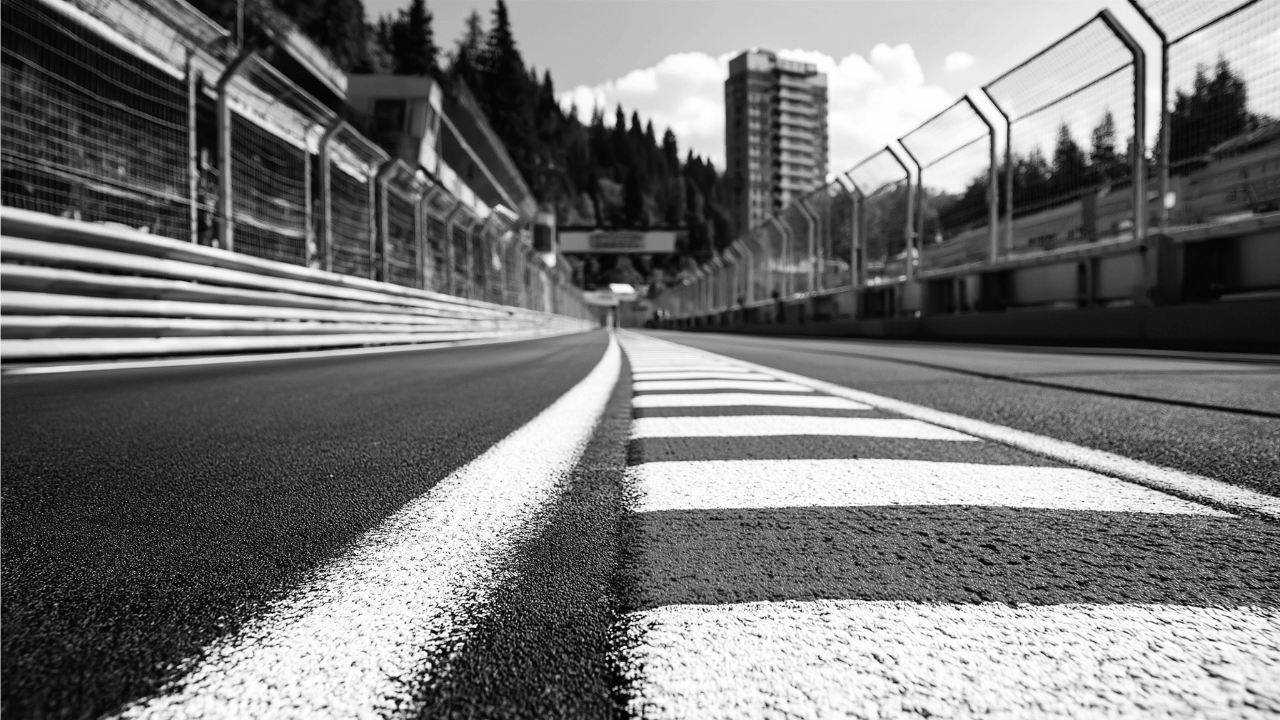
Formula 1 is, in part, a public exhibition of thermal management. Tyres, brakes, and the driver each have a narrow temperature window, often just a degree or two wide, and staying inside it is frequently the difference between winning and losing.
What the cars do
The cars are obvious. Engines run hotter than steam locomotives. Brake discs glow when the driver decelerates from 320 kilometres per hour into a hairpin. Tyres are designed to operate inside a narrow temperature window, and the entire pre-race ritual of warm-up laps and tyre blankets exists because tyres outside that window cannot deliver grip.
What is less obvious is the precision involved. Pirelli's tyre window in the modern era sits inside a range of roughly twenty degrees. The optimal grip temperature is closer to a point than a range. Engineers track tyre core temperature in real time, lap by lap, and the driver's job, when the team radios them, is to manage tyre temperature as much as it is to drive the racing line.
The same is true for brakes. Carbon-ceramic brake discs work in a window roughly between 400 and 1000 degrees Celsius. Below 400, they barely bite. Above 1000, they begin to fail. Drivers brush the brakes during slow corners not to slow the car but to keep the discs in the working window. The whole thing is a continuous thermal calibration that the audience is not watching.
What the drivers do
The drivers themselves are inside a sealed cockpit that reaches 50 degrees Celsius during a race. Heart rates average 170 beats per minute for two hours. Drivers lose three to four litres of body water per race. Mercedes, Ferrari, and McLaren have specialist sports scientists managing driver hydration, pre-cooling, and in-race cooling shirts. Research published in the European Journal of Sport Science has shown that driver cognitive performance, particularly reaction time and decision making in late race scenarios, correlates more strongly with core temperature than with hydration status.
This matters because motorsport has known for a long time what the rest of sport is slowly arriving at. Thermal management is not a side concern. It is one of the central performance variables, on the car and on the driver. And the marginal returns on managing it well are enormous.
A race engineer once described his job as ten percent strategy and ninety percent temperature.
The pattern across high-margin environments
The pattern that recurs, looking at any environment where performance margins are small, is the same. The teams that understand thermal management win more often than the teams that do not. McLaren's recent dominance in cooling system design, Mercedes' wind tunnel work on driver heat extraction, Ferrari's brake duct innovations: these are not exotic edges of the sport. They are the sport.
Why most of athletic culture has not caught up
The broader question is why most of athletic culture sits on the other side of this divide. F1 teams treat one degree as a meaningful variable. A weekend triathlete might not think about temperature at all. An elite track athlete probably has a pre-cooling protocol. A club-level cyclist almost certainly does not. The science is not the bottleneck. The science is settled. The bottleneck is whether the variable has been built into how people train. Closing that gap for the athlete between efforts is exactly what KYLA Performance™ is built for.
F1 is useful because it makes the principle visible. When a sport gets serious enough that every variable is measured and managed, temperature is one of the first variables that gets measured and managed. Not because someone decided to be thorough. Because they discovered they could not win without it.