
There is a part of every training session that nobody is really thinking about.
It is not the warm-up. It is not the working sets. It is not the cooldown.
It is the gap.
What the body does in that gap, moving heat out and recalibrating, decides what the next set can do.
The minute and a half between sets of squats. The two minutes between intervals on the bike. The thirty seconds between rounds on the bag. The handful of moments that, added together across a session, account for as much elapsed time as the work itself, and that the entire training and recovery industry has more or less ignored.
Rest is not absence
The convention is to treat rest as absence. No effort, no output, a pause in the system. From the outside it looks like nothing is happening. From the inside, the body is doing the opposite of nothing. Heart rate is still elevated. Blood is being redistributed. Lactate is being cleared. Heat is being moved out of the working muscles toward the skin. Systems are recalibrating. The body is preparing for the next effort.
What happens during that minute and a half determines what is possible in the set that follows.
Where heat accumulates or doesn't
This is the part of the session where heat accumulates or doesn't. The set produced heat. The body now has the rest period to move that heat away from the core. If the body can move enough of it out, the next set starts close to the same internal conditions as the previous one. If it can't, the next set starts hotter than the last. Across a full workout, that gap compounds.
By the fifth set of a five-set workout, the athlete is performing at a meaningfully different internal temperature than they were in the first set. The load on the bar is the same. The body underneath the bar is not.
Most training spreadsheets do not capture this. They capture load, sets, reps, and sometimes RPE. They do not capture what the body is carrying into each effort. They assume identical conditions across the workout, when the conditions are anything but identical.
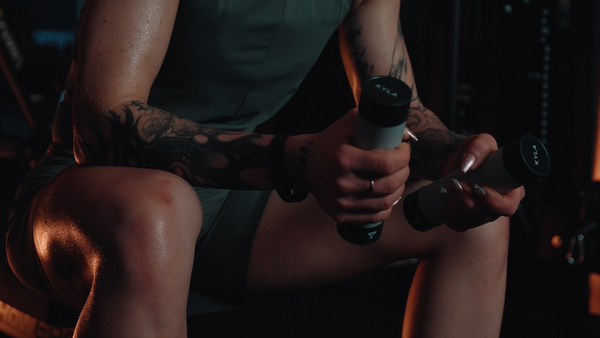
The moment KYLA was built around
This is the moment KYLA was built around.
Not training itself. Not recovery in the post-session sense. The rest period between efforts. The window where the body is trying to reset, with limited time and limited tools.
Most athletes use that window to scroll a phone, drink water, or stare at a wall. Useful things, none of which help the body move heat. The body is asking for an outlet during that window. Until recently, there has not been one available that was small enough to live inside a real training session, considered enough to feel like part of the brand of someone who takes their training seriously, and effective enough to actually do something measurable.
That gap is the brief KYLA was written against. Build a tool for the part of training that is not yet a tool category. Build it for the moment that everyone is in and nobody is using.
Transitions, not gaps
We tend to think of training as a sequence of efforts separated by rest. The frame we would propose instead is this. Training is a sequence of efforts and the transitions between them. The transitions are not the dead air between sets. They are where the next set is decided.
If you are serious about output across repeated effort, the question is not just how hard you can train. It is what you do with the time in between.
The brand is built on that one observation. The methodology page details how we measure what happens in that window. Everything else follows.
Frequently asked questions
Why does the rest between efforts matter so much?
Because it is not empty time. During rest the body clears lactate, redistributes blood, and moves heat out of the working muscles. What happens in those minutes shapes how the next effort goes.
How long is the rest we are talking about?
The short windows training already contains: the minute or two between sets, intervals, or rounds. Added across a session they total as much time as the work itself.
What can you actually do with that rest?
Use it deliberately instead of passively. Steady the breath, and shed some of the heat that built up in the last effort so you carry less of it into the next one.