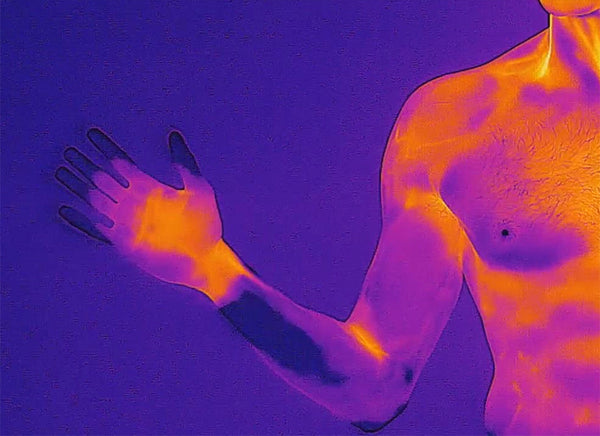

No. Colder is not better. Below a certain skin temperature the vessels that carry heat into the palm close down, and a surface that is very cold but gives up its cold quickly moves less heat than a moderate one that holds. Two things decide how much heat actually leaves: the temperature, and how much heat the surface can keep taking away.
Most cooling products are sold on a single number. Degrees. It is the easiest thing to print on a box and the easiest thing for a buyer to compare, so a device offering 8°C looks like it must beat one offering 14°C.
The palm does not work that way. It is one of the few places on the body where the surface temperature is not the thing doing the work. The blood is. And how much blood arrives at the surface depends on how cold that surface is, in a direction most people find counterintuitive.
Two numbers decide how much heat leaves, not one
Heat moves from your hand into a cool object for the same reason it moves anywhere: a difference in temperature. The larger the difference, the faster heat crosses the boundary.
That is the first number, and it is the one everybody quotes.
The second number is how much heat the object can absorb before it stops being cool. Put your hand on a cold stone and it stays cold. Put your hand on a cold sheet of paper and within a second it is the temperature of your hand. Both started at the same temperature. Only one of them removed any meaningful amount of heat.
Engineers call this thermal mass and conductivity. In practice it is simpler than it sounds: a surface that warms up to your skin temperature has stopped working, whatever it said on the box. If a rest period lasts two or three minutes and the surface stops being cool after twenty seconds, you spent most of the rest holding a warm object.
So the useful question is not how cold something is at the moment you pick it up. It is how much heat it can carry away across the whole rest, and whether it can keep doing it for the fourth set as well as the first.
Why colder stops helping
The palm is glabrous skin, meaning skin without hair, and underneath it sits a structure most of the body does not have. Arteriovenous anastomoses, usually shortened to AVAs, are short direct connections between small arteries and small veins that bypass the fine capillary network entirely.
Walløe (2016) describes the density as roughly 600 per square centimetre in the nail beds and around 100 per square centimetre in the thenar and hypothenar regions of the palm. Their only plausible transport function is heat. They exist to move it out of the body.
They are also densely innervated and under active control, and this is where the temperature argument turns. When they are cold, they close. That is why your hands go cold first on a winter morning: the body shuts the shunts to stop losing heat through them.
The consequence for a cooling device is direct. Cool the palm enough and the vessels constrict. Less warm blood arrives at the surface. There is less heat there to remove, and the impressive temperature difference is now operating on a surface the body has largely stopped supplying. The mechanism that makes the palm efficient is the same mechanism that can be switched off by overdoing it.
This is why KYLA Performance is engineered to hold around 14°C rather than the coldest temperature it could reach. It is a deliberate ceiling, not a limitation.
Where exactly the threshold sits is not settled
Here is the part most cooling companies leave out.
The clearest experimental account of the shutdown comes from work summarised by Walløe, in which a single finger was immersed in a temperature-controlled water bath. Cooling from 35°C to 27°C left the characteristic blood velocity fluctuations unchanged. When the bath was lowered further, the fluctuations stopped abruptly in every subject once local temperature dropped below roughly 21.5°C, and blood velocity stayed low. The vessels remained closed.
Read strictly, that number sits above the temperature at which our own tool operates.
We think the situations are different in ways that matter. That experiment immersed one finger, continuously, in water, in a subject at rest near the top of their thermoneutral zone. Holding a cool surface in both palms during the rest between hard efforts, with a raised core temperature and the shunts already wide open, is not the same problem. Contact is partial rather than total, the exposure is intermittent, and the body is in an entirely different thermal state.
But we cannot prove that from the published literature, because no study has directly compared cooling temperatures for palm cooling during exercise. Nobody has run 8°C against 14°C against 20°C in the same protocol and reported what happened. Until somebody does, any specific temperature claim in this category, including ours, rests on physiology and engineering rather than on a head-to-head trial.
What we can say is the direction: at some point colder stops helping and starts hurting, the mechanism for that is well described, and designing toward the coldest achievable number ignores it.
What the studies that worked actually used
The most useful published result for this question is Iwahashi et al. (2023). Eleven physically active men performed an intermittent cycling protocol in 33°C heat, split by a fifteen minute half-time. During half-time they either sat still or immersed their hands and forearms in water at 15 to 17°C.
Mean power output in the second half was significantly greater in the cooling condition. Rectal temperature fell by 0.54°C during half-time, and the athletes reported feeling more comfortable in the second half.
Two things are worth noticing.
The first is the temperature. Not ice water. Not the coldest thing available. Fifteen to seventeen degrees, which is a moderate, deliberately unremarkable band.
The second is the method. Water immersion of the hands and forearms is close to the maximum heat transfer capacity you can achieve without freezing tissue. A large volume of water at a stable temperature, in full contact with a large surface area, for fifteen uninterrupted minutes. If temperature alone were the variable, a colder and smaller intervention should have done better. It is the combination of a moderate temperature and an enormous capacity to keep absorbing heat that produced the result.
There is one more detail in that study that cuts against the simple version of our own argument, and it belongs here. Skin blood flow at the end of half-time was 40.2% lower in the cooling condition. Vasoconstriction happened, at 15 to 17°C, and performance improved anyway. The relationship between constriction and benefit is evidently not a simple switch, and anyone telling you it is, including us, is simplifying.
The evidence is genuinely mixed, and the method is usually why
Palm cooling has produced null and negative results as well as positive ones. Scheadler et al. (2013) found that runners reached exhaustion sooner with a cooling device worn during the run, 41.3 minutes against 46.7. Kenville et al. (2024), the largest palm cooling study in resistance training, cooled the full three minute rest at 13 to 15°C and found pull-up repetitions fell from 38.2 to 32.2, with no effect either way on push-ups or leg extensions.
We publish both of those on our references page alongside the positive results, because the honest summary of this field is that the effect is real, contested, and highly sensitive to method.
Which is the point of this article. What device, at what temperature, held when, for how long, in what kind of session. Those variables move the result more than the presence or absence of cooling does. A number of degrees on a box tells you almost nothing about any of them.
What this means for training
If you are choosing between cooling methods, the questions worth asking are not about the lowest achievable temperature.
Ask whether the surface stays cool for the whole rest or gives up after twenty seconds. Ask how much of the palm it actually contacts. Ask whether it is being used between efforts, which is where the evidence sits, or during them, which is where several of the negative results come from. And ask what happens on the fourth round, when both you and the device have been working for a while.
An ice pack is very cold and has almost no useful capacity at the palm, because the surface it presents is small, the temperature is low enough to close the vessels, and the sensation drowns out the feedback you would use to judge it. That is not a marginal design difference. It is a different outcome.
We publish what we measured, and the limits of those measurements, on our methodology page. KYLA Performance is built around a held temperature rather than a peak one, for the reasons above.
The tool does not replace the work. It lets more of the work count.
Common questions
Is colder always better for cooling the body?
Not through the palms. The palms move heat using vessels that constrict when they get cold, so past a point additional cold reduces the amount of heat available at the surface to remove. Cooling a large area of ordinary skin behaves differently, which is part of why cold water immersion and palm cooling are not interchangeable.
What temperature should palm cooling be?
No published study has compared temperatures directly for palm cooling during exercise, so there is no evidence-based answer to give. The clearest positive result used water at 15 to 17°C. KYLA is engineered to hold around 14°C. Anyone quoting a precise optimum is quoting a design decision, not a finding.
Why does an ice pack feel more effective if it moves less heat?
Because sensation and heat transfer are not the same measurement. Very cold surfaces produce a strong nerve response almost immediately, which reads as effectiveness. Meanwhile the vessels underneath are closing, the ice is warming toward its melting point, and contact area is usually poor. The feeling is stronger and the effect is smaller.
Does the size of the cooling surface matter?
Yes, in two ways. Contact area determines how much of the palm is participating, and the mass behind that surface determines how long it can keep absorbing heat before it warms to skin temperature. A small very cold object and a larger moderately cool one can start at very different temperatures and end up moving very different amounts of heat, usually in favour of the second.
References
Walløe, L. (2016). Arterio-venous anastomoses in the human skin and their role in temperature control. Temperature (Austin), 3(1), 92-103. PMID 27227081. doi:10.1080/23328940.2015.1088502
Iwahashi, M., Chaen, Y., Yanaoka, T., Kurokawa, Y. & Hasegawa, H. (2023). Cold water immersion of the hand and forearm during half-time improves intermittent exercise performance in the heat. Frontiers in Physiology, 14, 1143447. PMID 37362443. doi:10.3389/fphys.2023.1143447
Scheadler, C. M., Saunders, N. W., Hanson, N. J. & Devor, S. T. (2013). Palm cooling does not improve running performance. International Journal of Sports Medicine, 34(8), 732-735. PMID 23444094. doi:10.1055/s-0032-1327576
Kenville, R., Clauß, M., Arup, A., Ragert, P. & Maudrich, T. (2024). No effect of intermittent palm or sole cooling on acute training volume during resistance exercise in physically active adults: a summary of protocols. Sports, 12(10), 281. PMID 39453247. doi:10.3390/sports12100281
The full set, including the studies that found no benefit, is on our references page.